


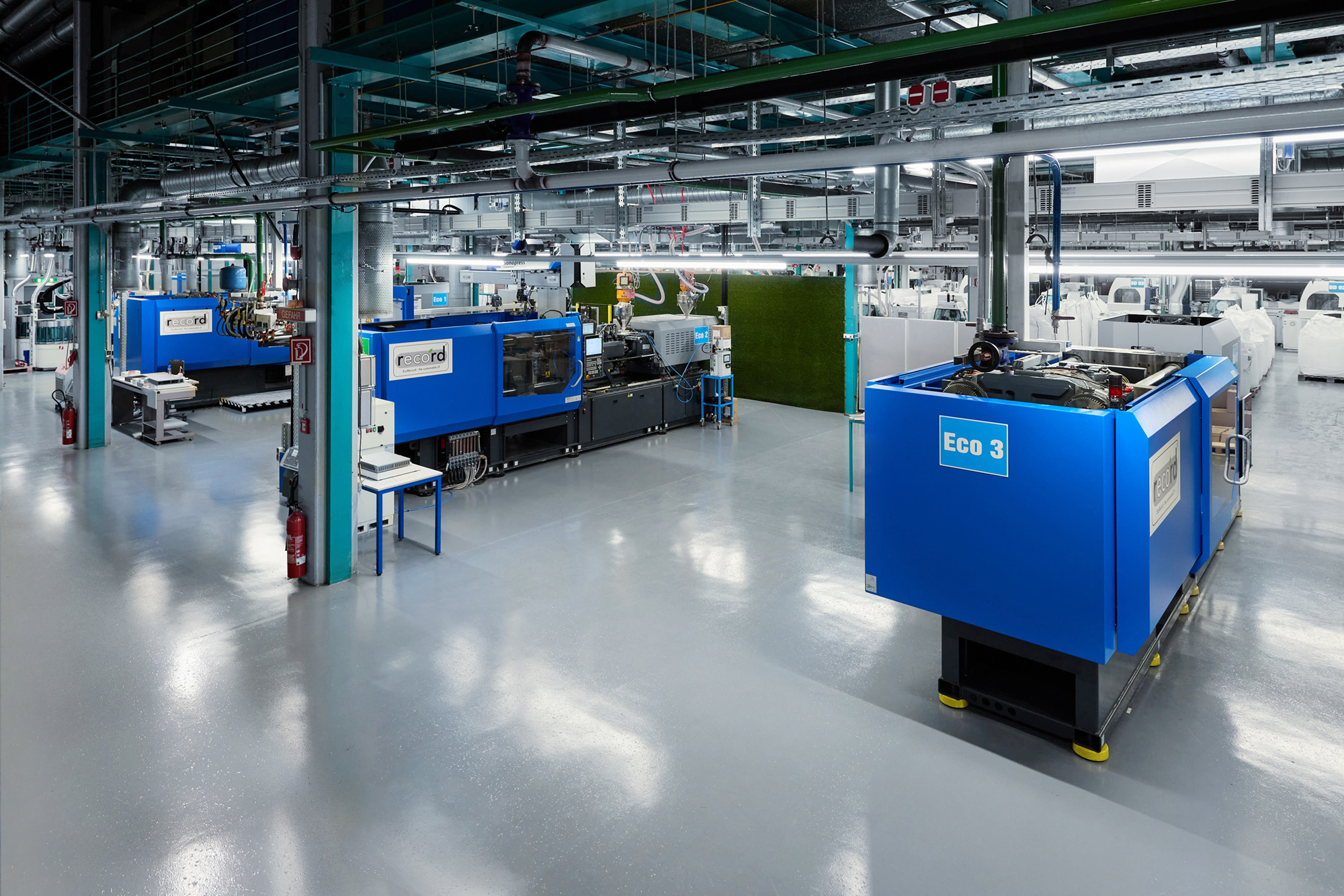
Gütersloh/Haarlem, 29 September 2026 – Sonopress plans to expand the global EcoRecord production capacity to a total of 15 machines by 2029. The announcement was made by the leading manufacturer of physical music products ahead of this year’s Making Vinyl Europe industry conference, taking place in Haarlem, the Netherlands, from 30 September to 2 October. Sonopress Managing Director Sven Deutschmann said: “EcoRecord has successfully established itself in the market. In response to continuously growing demand, we plan to commission ten additional state-of-the-art injection-molding machines by 2029 to produce this PET-based LP format.”
Sonopress currently produces EcoRecord LPs on three machines at its Gütersloh site in Europe and on one additional machine at its Charlotte, North Carolina, site in the United States. In December 2026, a fifth EcoRecord machine will be installed at the Guadalajara, Mexico, site of Sonopress’s cooperation partner Conectiv.
The investment program will begin with two additional machines scheduled to be installed at the Gütersloh site during the first half of 2027. In the following years, eight additional machines are scheduled to be commissioned. The expansion will strengthen Sonopress’s international production network and create the capacity required to ensure global supply in the future.
“EcoRecord has gained strong acceptance among our music-industry customers, from major labels to independent labels. Companies, artists and consumers are increasingly looking for innovative alternatives. Demand is developing so dynamically that expanding our capacity is essential to ensuring global supply in the future,” said Sven Deutschmann.
The EcoRecord is an innovative alternative to the traditional PVC vinyl LP. It uses polyethylene terephthalate (PET) as its base material instead of polyvinyl chloride (PVC). It is manufactured using injection moulding, a process that, unlike conventional record pressing, uses neither natural gas nor steam. The EcoRecord can reduce CO₂e emissions by approximately 32% compared with a conventional pressed PVC vinyl LP; when recycled PET is used, the reduction can reach 76%. See below: EcoRecord.
“Our investments are a clear commitment to the future of physical music products and to our ambition to develop more innovative solutions for the future together with our customers. With ten additional machines by 2029, we are creating the foundation to bring EcoRecord to even more artists, labels and music fans around the world,” said Sven Deutschmann.
EcoRecord: CO₂e Footprint and Energy Consumption Compared
In December 2021, international record labels and music companies joined forces to establish the Music Climate Pact. The initiative aims to measure the music industry’s greenhouse gas emissions and reduce them through individual and collective action. The Music Climate Pact & Vinyl Alliance Sustainable Supplier Program 2025 Report compares the product footprints of different LP materials and manufacturing processes as part of the programme launched in 2025. ClimatePartner was involved as an independent climate expert to transparently verify and impartially certify the results. The reference for the CO₂e figures is the global study average for a packaged, traditionally pressed 140 g / 12-inch LP made from virgin PVC: 0.93 kg CO₂e. Based on the report data, the following figures apply:
- Virgin PET, manufactured using injection moulding: 0.54 kg CO₂e per packaged LP – approximately 42% less CO₂e than the global study average for virgin PVC.
- 100% recycled PET, manufactured using injection moulding: 0.38 kg CO₂e per packaged LP – approximately 59% less CO₂e than the global study average for virgin PVC.
- Energy consumption: In the study comparison, the LP manufacturing process itself is calculated to require approximately 89% less energy when using injection moulding – 0.15 kWh per LP compared with 1.57 kWh for traditional pressing. The electroforming of pressing or moulding tools (stampers) is excluded from this energy comparison.
Basis of Calculation
The assessment considers the product footprint of an average black 140 g / 12-inch LP, including electroforming and manufacturing, as well as standard packaging consisting of a paper inner sleeve, a cardboard outer sleeve and shrink wrap. The calculation follows the GHG Protocol Product Standard and a cradle-to-gate approach. It covers the extraction or recycling of raw materials, the pre-processing of raw materials and packaging, delivery to the production site, and manufacturing up to the factory gate, including energy consumption and waste generation. Allocated operational overhead emissions are also included. Downstream distribution, use and the product’s end of life, as well as print finishes on the outer sleeve, are excluded. The CO₂e figures refer to the product configurations and production conditions used as the basis for the report.
We would be happy to send you the full report on request.


